
Emergency Loan Alternatives: Smarter Options Before Fast Cash
Explore smarter emergency loan alternatives in the U.S. Avoid high-interest debt with faster, safer options before borrowing fast cash.
Stop: Read This Before Taking an Emergency Loan

If you live in the United States and have ever typed “need money fast” into Google, you’ve seen what shows up first: payday loans.
Fast cash, no bureaucracy, easy approval. Now here’s the truth few people tell you: this is almost always a trap.
That’s because payday loans can charge the equivalent of 300% to 700% APR. As a result, many people end up stuck in a debt cycle that lasts for months.
If you’re thinking about taking an expensive emergency loan, you haven’t explored the best options yet.
This guide will show you exactly that: smarter, real alternatives used by everyday Americans.
🚨 Before anything else: understand the most common mistake
When financial stress hits, the usual thinking is:
“I just need to fix this right now.”
The problem is that this ignores the total cost.
Simple comparison
| Option type | Time to receive | Cost | Risk |
|---|---|---|---|
| Payday loan | Same day | Very high (300%+ APR) | Extremely high |
| Cash advance app | Same day | Low to medium | Medium |
| Credit union (PAL) | 1–3 days | Low (up to 28% APR) | Low |
| Local assistance | Varies | Free | None |
Conclusion: speed shouldn’t be your only criterion.
1. Cash Advance Apps (the “almost free” option that became standard)
Apps like EarnIn, Dave, Brigit, and MoneyLion are now among the most popular alternatives in the U.S.
How it works:
You access part of your paycheck before payday.
Real numbers:
- Amount: $50 to $1,000
- Interest: 0% (but with fees/tips)
- Transfer fee: up to ~$8
Market examples:
- EarnIn → tip-based model
- Dave → monthly subscription
- MoneyLion → up to $500 in quick advances
👍 Pros:
- Very fast (sometimes instant)
- No traditional interest
- Easy approval
👎 Cons (important):
- Hidden costs (transfer + subscription)
- Can become a habit → dependency cycle
- Automatic withdrawal on next paycheck
There are real cases of people getting stuck in this cycle, where apps automatically “eat” their paycheck.
Good for one-time emergencies. Terrible if it becomes routine.
2. Employer Paycheck Advance (the most underrated option)
Almost nobody uses this, and they should.
How it works:
You request an advance directly from your employer or through apps like:
- Payactiv
- DailyPay
- EarnIn (when integrated)
Key facts:
- Cost: usually zero or very low
- Time: same day or up to 3 days
👍 Pros:
- No interest
- No impact on credit
- Much safer than any loan
👎 Cons:
- Not all employers offer it
- May require talking to HR (uncomfortable)
If this option is available and you ignore it, you may be making a poor financial decision.
3. Credit Union Payday Alternative Loans (PALs)
This is, objectively, one of the best options available in the U.S.
How it works:
Credit unions offer small, regulated loans.
Numbers:
- Amount: $200 to $2,000 (typically)
- Max APR: 28%
- Term: up to 6 months
Compare that to payday loans: 28% vs. 400%+.
👍 Pros:
- Much cheaper
- Regulated
- Installment payments
👎 Cons:
- You must be a credit union member
- Not instant
If you truly need a loan, this should be your first choice.
4. Free assistance (yes, money you don’t have to repay)
This is a game changer, and almost nobody uses it.
Examples:
- 211 (national helpline)
- Rental assistance programs
- Energy assistance (LIHEAP)
- Food banks
Real impact:
Over 25 million services provided in 2025, based on recent data.
👍 Pros:
- Zero cost
- No repayment
- Can cover essential expenses
👎 Cons:
- Process may take time
- Doesn’t always cover everything
If you take out a loan before trying this, you’re leaving money on the table.
5. Personal Loans (when you need a larger amount)
If you need more (e.g., $2,000+), apps and advances won’t be enough.
Common options:
- Upstart
- Avant
- Oportun
Features:
- Fixed payments
- Lower APR than payday loans
- Consider more than just your credit score
👍 Pros:
- Predictable payments
- Better for planning
👎 Cons:
- Approval not guaranteed
- Interest still applies
Much better than payday loans, but still debt. Use strategically.
6. Emergency Fund (yes, you probably don’t have one — but you need it)
This won’t fix today, but it will fix your future.
Standard recommendation:
- Start with $500 to $1,000
Why it matters:
Because this entire problem exists when you don’t have savings.
Without an emergency fund, you’re always one problem away from making a bad financial decision.
Start now to rebuild your emergency fund.
📊 Side-by-side comparison
| Option | Cost | Speed | Best use |
|---|---|---|---|
| Cash advance apps | Low–medium | Immediate | Small amounts |
| Employer advance | Very low | Fast | Simple emergencies |
| Credit union PAL | Low | Medium | Structured debt |
| Assistance (211) | Zero | Varies | Basic needs |
| Personal loan | Medium | Medium | Larger amounts |
| Payday loan | Extremely high | Immediate | Avoid |
🧠 The truth no one tells you
The problem isn’t “lack of money.”
The problem is urgency + lack of information.
Payday loans exist because they are:
- easy
- fast
- require no planning
But that doesn’t make them the best option, it makes them the most convenient.
And financial convenience almost always comes at a high cost.
Image to save on your phone
Save this image and review it before applying for a loan.
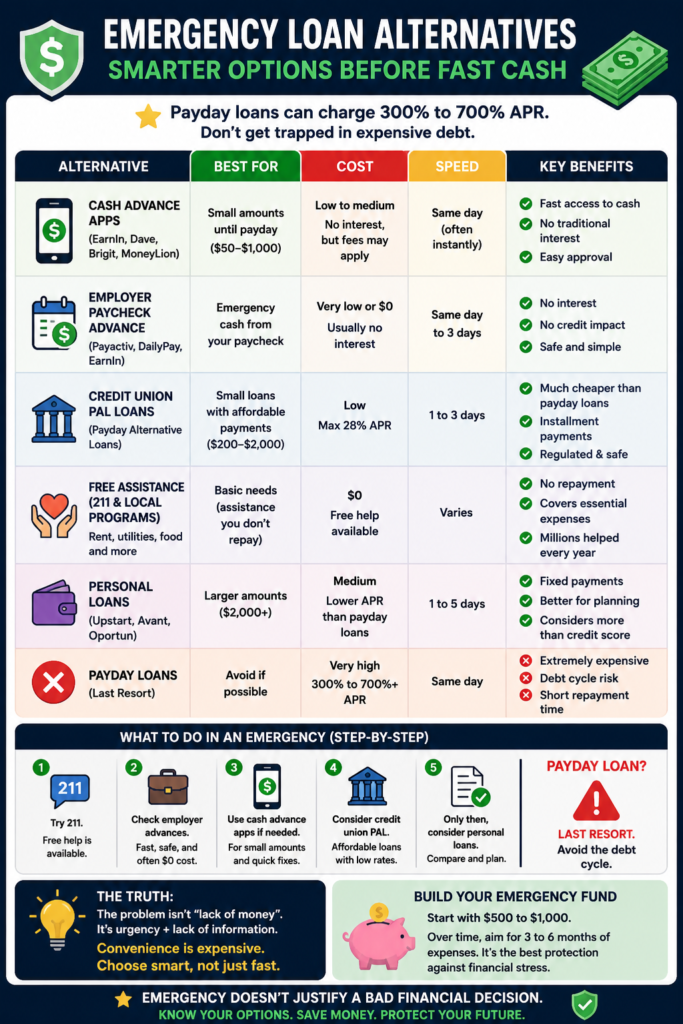
✔️ Practical strategy (what to do now)
If you’re facing an emergency TODAY:
- Try 211 (free assistance)
- Check if your employer offers advances
- Use a cash advance app (light last resort)
- Consider a credit union PAL
- Only then consider a traditional loan
👉 Payday loan? Absolute last resort.
Conclusion (no fluff)
If you need money fast, you have options. But not all options are equal.
👉 Clear position:
- Payday loans are a fast but bad solution
- Better, cheaper, smarter alternatives exist
- The best move isn’t the fastest — it’s the most sustainable
If you take one thing from this:
An emergency does not justify a bad financial decision.
If you want, I can build a step-by-step plan based on your real situation (amount, timeline, credit).
FAQ — Emergency Loan Alternatives

Related content
Too Much Company Stock? Here’s the Real Risk
Understand the hidden risk of being financially dependent on a single company in the U.S. and how to protect your wealth.
Keep reading * You will remain on the current website
I have been a content producer for over 10 years, specializing in online writing across a wide range of topics—particularly finance, health, and human behavior. I’m an expert in SEO-driven writing and cultural research.