Open Enrollment Insurance Checklist Before You Pick Benefits
Use this Open Enrollment Insurance Checklist to compare plans, lower risks, and avoid costly coverage mistakes.
What Most Employees Miss
Every fall, millions of Americans open their employee benefits portal with the same enthusiasm people use when reading app terms and conditions:
“Sure, whatever. Continue.”
That approach works fine for streaming subscriptions.
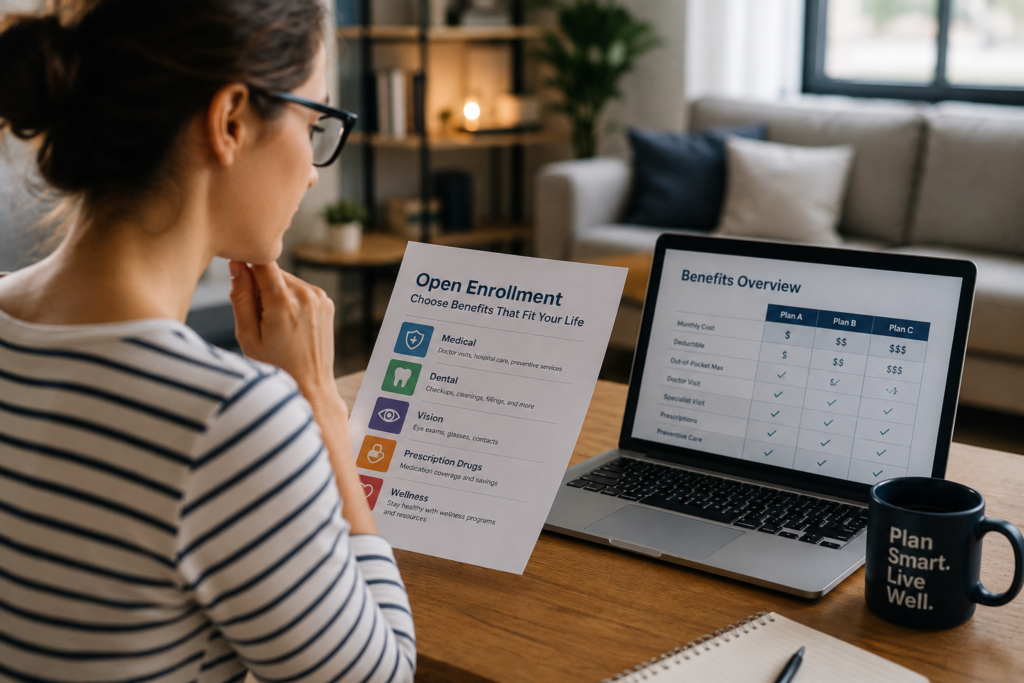
It does not work for health insurance.
The Open Enrollment Paradox
Open enrollment is one of the most important financial decisions most workers make every year, yet many people spend more time comparing:
And in the United States, a weak insurance decision can become painfully expensive very fast. Medical costs can lead to:
That’s why having a proper Open Enrollment Insurance Checklist matters.
Not because insurance is exciting — it definitely is not — but because choosing blindly is one of the easiest ways to damage your finances without realizing it.
Why Most Employees Pick the Wrong Plan
A huge number of Americans choose benefits based on one thing only: “Which plan takes less from my paycheck?”
That sounds reasonable at first.
But monthly premiums are only one part of the equation.
You also need to evaluate:
- deductibles,
- out-of-pocket limits,
- prescription costs,
- provider networks,
- specialist access,
- coinsurance,
- emergency coverage.
Sometimes the “cheap” plan becomes extremely expensive the moment you actually use it.
That’s the part employers and insurance companies rarely explain clearly.
Your Open Enrollment Insurance Checklist
Before selecting benefits, review these categories carefully:
📊 The 10-Point Coverage Matrix
What to evaluate before locking in your plan
Skipping these details is how people end up shocked by bills later.
Stop Looking Only at Monthly Premiums
This is probably the biggest mistake during open enrollment.
Example:
⚖️ Plan Comparison Breakdown
The Trade-Off: You either pay the insurance company guaranteed money every month (Gold), or you keep the cash but take on the financial risk yourself (Bronze).
The HDHP saves: $175 per month. That sounds fantastic.
Until:
- your child fractures an arm,
- you need an MRI,
- a surgery appears unexpectedly,
- or prescriptions become necessary.
Suddenly, the lower premium no longer feels cheap.
A lot of Americans underestimate how quickly medical costs pile up in the U.S. system.
One emergency room visit alone can wipe out months of savings.
Deductibles Matter More Than Most People Realize
Many workers don’t fully understand what a deductible actually means.
Simple version: your deductible is the amount you pay before insurance starts covering many major expenses.
Example:
- Deductible: $5,000
- Medical bill: $3,200
You could still owe almost the entire amount yourself.
That’s why some people feel confused after receiving large bills despite “having insurance.”
Insurance does not always mean immediate financial protection.
PPO, HMO, and HDHP: Which One Fits Best?
These plan types confuse almost everyone at first.
Here’s the practical breakdown.
🏥 Health Plan Architecture
Strengths vs. Weaknesses of each structure
PPO
Preferred Provider OrganizationHMO
Health Maintenance OrganizationHDHP
High Deductible Health PlanPPO Plans
PPO plans are usually best for:
- families,
- people with chronic conditions,
- workers seeing specialists regularly,
- employees wanting provider flexibility.
Advantages
- Easier specialist access
- Larger doctor networks
- Better for ongoing medical care
Drawbacks
- Higher monthly premiums
- Bigger payroll deductions
For many middle-class families, PPO plans provide more predictable healthcare spending.
HMO Plans
HMO plans work better for:
- healthy individuals,
- people wanting lower monthly costs,
- workers comfortable staying within a smaller network.
Advantages
- Lower premiums
- Simpler structure
Drawbacks
- Requires referrals
- Less provider flexibility
- Out-of-network issues can become expensive
HMOs are not automatically bad.
But they require more planning.
HDHP Plans and HSAs
This is where financial blogs often oversimplify things.
Online finance influencers love promoting HSAs.
They offer:
- tax-deductible contributions,
- tax-free investment growth,
- tax-free medical withdrawals.
That is a rare triple tax advantage.
But here’s the problem:
Many people promoting HDHPs already have:
- strong savings,
- stable income,
- low medical usage,
- predictable healthcare costs.
That’s not everyone.
An HDHP can become financially stressful if:
- you live paycheck to paycheck,
- you have children,
- you deal with chronic conditions,
- or your emergency fund is weak.
A lot of Americans choose HDHPs for the lower premium and later realize they cannot comfortably handle the deductible.
That’s the part social media finance advice often ignores.
Always Check the Provider Network
This sounds boring.
It becomes very exciting after a surprise medical bill arrives.
Insurance networks change constantly.
A doctor covered last year may not be covered this year.
Before selecting benefits, verify:
- primary care doctors,
- specialists,
- nearby hospitals,
- pediatricians,
- urgent care locations,
- therapists.
Mental health networks are especially inconsistent across many insurance providers in America.
That matters more than people think.
Prescription Coverage Can Change Everything
Prescription costs in the United States are wildly inconsistent.
💊 The Prescription Coverage Trap
Two insurance plans with similar premiums can produce completely different prescription costs. This is critical if you need:
⚠️ How Plans Hide Costs
- ✖ Limit pharmacy choices
- ✖ Push medications into expensive tiers
- ✖ Require prior authorizations
- ✖ Increase copays significantly
🔍 What You Must Review
- ✔ Formulary lists
- ✔ Pharmacy requirements
- ✔ Medication tiers
- ✔ Mail-order restrictions
Compare the Full-Year Cost — Not Just the Monthly Cost
This is the smartest financial move during open enrollment.
Instead of asking:
“What’s the cheaper plan?”
Ask:
“What’s my realistic yearly healthcare cost?”
Calculate:
- annual premiums,
- expected doctor visits,
- prescription costs,
- specialist usage,
- emergency risk.
Example:
⚖️ The Head-to-Head Comparison
A healthy single worker may prefer the HDHP.
A family with children probably sees a completely different outcome.
That’s why copying coworkers’ choices is not smart.
Their medical needs are not your medical needs.
🏢 Honest Breakdown of Major U.S. Insurance Companies
No insurance company is universally amazing. Experiences vary heavily depending on: state, employer-negotiated plans, provider networks, and claims handling. Still, some trends consistently appear.
Think About Worst-Case Scenarios
This is where mature financial planning matters.
Insurance is not about “winning.”
It is about limiting damage.
Ask yourself:
- What happens if I need surgery?
- What if my child is hospitalized?
- What if I need long-term specialist care?
- What if an emergency happens while savings are low?
A plan that feels cheap during healthy years may become financially brutal during medical stress.
That’s why the lowest premium is not automatically the smartest choice.
Questions You Should Ask Before Enrolling
🗣️ The HR Pre-Enrollment Checklist
Before choosing benefits, do not guess. Ask HR these exact questions:
Most employees never ask these questions. Then they are surprised later by costs they could have predicted.

Related content
How to Plan Your Tax Refund Before It Arrives
Learn how Americans can strategically plan a tax refund before it arrives to reduce debt and build wealth.
Keep reading * You will remain on the current website
I have been a content producer for over 10 years, specializing in online writing across a wide range of topics—particularly finance, health, and human behavior. I’m an expert in SEO-driven writing and cultural research.