Why Are Monthly Car Loan Payments Increasing Across the U.S.? Exploring the Rise in Financing Costs
Although some interest rates are dropping, car loan payments continue to climb. Discover the factors behind these increasing costs and find out how you can reduce your auto financing expenses.
Why More Americans Are Struggling to Keep Up with Car Payments
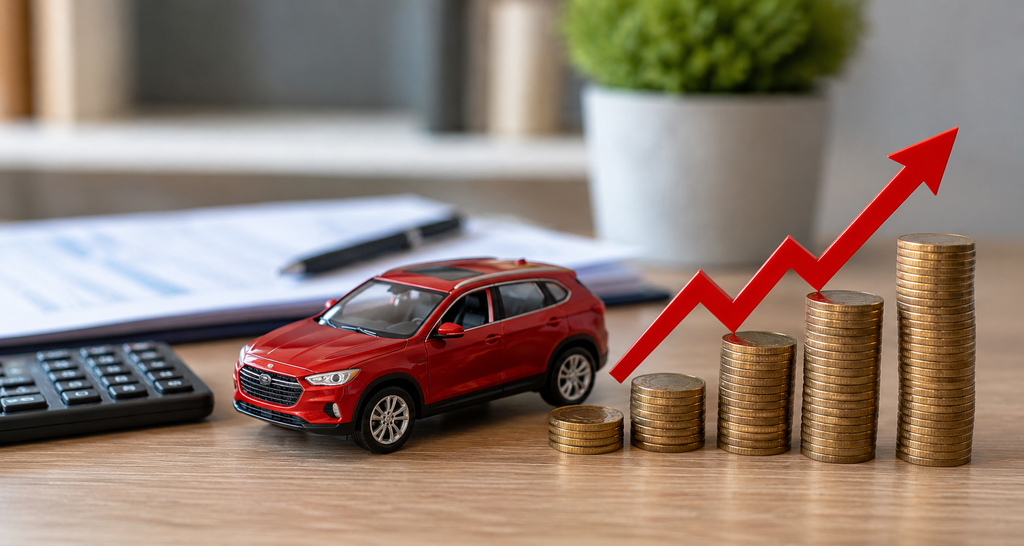
If your monthly car payment seems significantly higher than before, you’re not just imagining things.
There’s a key factor to understand here: your monthly payment can increase even if car loan interest rates don’t go up.
Factors like rising vehicle prices, bigger loan amounts, smaller down payments, rolling over negative equity, and longer loan terms can all push your monthly cost higher.
Here’s what’s truly behind the rising car financing expenses in 2026.
What’s Causing Car Loan Payments to Rise?
Monthly payments on vehicle loans are climbing mainly because buyers are taking out larger loans to afford their cars.
Meanwhile, interest rates continue to stay well above the historically low levels that were common before and during the pandemic’s early phase.
According to Experian’s data from the second quarter of 2026:
These figures highlight why focusing solely on interest rates can give a distorted picture.
In fact, the average interest rate on new-car loans dropped from 6.79% to 6.35% year over year, yet monthly payments rose by $16.
The reason? Borrowers are financing larger amounts than before.
This difference matters a lot when you’re figuring out if a car really fits your budget.
Rising vehicle prices lead to bigger loan amounts
Kelley Blue Book reports that in July 2026, the average price paid for a new vehicle hit $49,855.
This marks a 1.9% increase from the previous year and stands as the highest price recorded in 2026 so far.
Even a modest rise in the vehicle’s cost can significantly impact payments when the amount is spread out over multiple years.
For instance, taking out an extra $3,000 loan doesn’t just add that amount to your bill—you’ll also owe interest on the borrowed sum.
And that’s before factoring in taxes, fees, dealer extras, and other charges that might be included in the loan total.
Longer loan durations can mask the true expense
Extending the length of your car loan is one of the simplest ways to make monthly payments seem more affordable.
Loans stretched over 72 or 84 months often have lower monthly payments than those lasting 48 or 60 months, but borrowers end up paying interest for a much longer time.
According to NerdWallet, the average new-car loan duration in Q1 2026 was about 69.5 months, while used-car loans averaged roughly 67.7 months.
This shows that most borrowers are financing their vehicles for nearly six years already.
While your monthly payment might seem affordable now, the overall amount paid over time can be much higher.
How your credit score greatly impacts your monthly payment
The rate advertised online often isn’t the exact rate you’ll qualify for in your loan offer.
For instance, Bankrate’s national auto-loan index assumes a specific borrower profile, including a 700 FICO score, set loan amount, and down payment.
NerdWallet’s August 2026 study highlights notable variations in average rates depending on the borrower’s credit profile.
The analysis references July 2026 average rates near 7% for new cars and 10.6% for used cars according to Edmunds, while Cox Automotive’s Dealertrack data indicates even higher average interest rates.
If your credit score falls below prime, the interest rate you receive could be much higher than the advertised headline rate.
What Factors Are Driving Car Financing Costs in 2026?
Multiple factors are combining to reduce affordability all at once.
Vehicle prices continue hovering near $50,000
With the average price of a new car nearing $50,000, the financial commitment today is quite unlike what many Americans faced a decade ago.
According to Kelley Blue Book’s July report, the average transaction price for a new vehicle was $49,855.
That elevated base price influences many aspects further along the financing chain:
- the amount financed;
- the monthly payment;
- the interest paid;
- the required down payment;
- the amount of income needed to comfortably afford the vehicle.
That’s why concentrating solely on the APR can sometimes be misleading.
Interest rates continue to play a key role in financing costs
According to Bankrate’s August 26 report, average interest rates were 6.94% for a 60-month new-car loan and 7.43% for a 48-month used-car loan.
While these rates are below some of the highest levels seen in recent years, they remain elevated enough to significantly impact the overall price of a vehicle.
Used-car buyers, however, often encounter an extra hurdle.
Experian’s Q2 2026 data showed the average interest rate for used-car loans at 11.19%, a slight drop from 11.57% a year prior.
Borrowers with lower credit scores often face even higher APRs than the average rates.
How the Federal Reserve influences—but doesn’t set—your auto loan rate
Many people assume a Fed rate cut immediately lowers car payments, but that’s not necessarily true.
Because most auto loans have fixed interest rates, payments on existing loans usually stay the same even if the Fed adjusts its benchmark rate.
Still, Fed policies shape overall lending conditions, which can impact the interest rates lenders offer on new car loans.
That’s why it’s important for consumers to understand the difference between the Fed’s policy rate and the APR on a specific auto loan.
What Are Americans Paying for Cars in 2026?
Recent data from Experian highlights just how costly financing has become for the typical car buyer.
Payments on New Cars
In Q2 2026, the average monthly payment for a new car hit $765, up from $749 the previous year.
NerdWallet’s data from Q1 revealed a comparable average payment of $770 per month.
Payments for used cars
While used cars cost less to finance in total dollars, that doesn’t always mean they’re affordable.
According to Experian, the average monthly payment for a used car was $542 in Q2 2026, rising from $532 a year earlier.
The typical APR for used-car loans stood at 11.19%.
Is August 2026 a Smart Time to Purchase a Car?
August could present some advantages for certain buyers. However, a discount alone doesn’t guarantee that financing will be affordable.
How Model-Year Changeovers May Open Doors
Dealerships are starting to receive 2027 models, though the rollout is progressing more slowly than it did last year.
According to Kelley Blue Book, 2027 models accounted for only 5.6% of the inventory in July, significantly less than the share seen during the same period last year.
Shoppers might discover deals on leftover 2026 models, though the selection and incentives can differ widely between vehicles.
Labor Day promotions often include financing offers
Labor Day is on September 7, 2026, making the end of August a key time for car buyers.
Cox Automotive forecasts that August sales will hold steady around a 16.3 million seasonally adjusted annual rate.
However, the raw number of vehicles sold in August is expected to drop compared to last year, mainly due to calendar shifts.
Car makers are also offering incentives to help boost their sales.
According to J.D. Power’s August forecast, average incentives per vehicle are climbing to about $3,384, a 5.9% increase compared to last year.
However, buyers should focus on the total cost of financing, not only the upfront discounts advertised.
A $3,000 rebate combined with a high-interest rate might not be better than a smaller rebate paired with a much lower APR.
What Should You Know About the New Auto Loan Interest Tax Deduction?
A key update for U.S. car buyers is the federal tax deduction now available on certain new auto loan interest payments.
Still, this benefit shouldn’t be used as justification for borrowing more than you can afford.
Remember, a tax deduction doesn’t reduce the actual interest you owe your lender.
Cox Automotive’s Chief Economist Jonathan Smoke told CNBC that the expected savings from an average new loan would be relatively small—around $500 or less in the first year, depending on an individual’s tax situation.
Put simply: don’t justify spending an extra $5,000 on a car just because you might get a tax break on the interest.
Will Car Loan Payments Become More Affordable?
There’s no certainty on this front. Current trends present a mixed scenario.
For example, some auto loan interest rates have dropped. Experian noted year-over-year declines in average rates for both new and used cars.
However, vehicle prices remain high, and the typical loan amount continues to climb.
Cox Automotive estimated that the average auto loan rate for July was 9.52%.
New-vehicle affordability has stayed largely steady as income gains and steady interest rates balanced out slight increases in vehicle prices.
This indicates buyers shouldn’t count on interest rates dropping enough soon to make today’s costly vehicles much more affordable.
Key Factors to Review Before Committing to an Auto Loan
Make sure to review these details before you finalize your loan:
- 1. APR
- 2. Amount financed
- 3. Loan term
- 4. Total interest
- 5. Trade-in balance
- 6. Add-ons
- 7. Total ownership cost
The Author’s Perspective
One of the biggest errors buyers can make in 2026 is concentrating on the monthly payment rather than the vehicle’s overall expense.
Sitting in a dealership, a $600 monthly payment might seem reasonable and tempting.
However, that payment often comes with an 84-month loan, a minimal down payment, and a large balance carried over from your trade-in.
Given that average car prices still hover near $50,000, it’s crucial to keep this in mind in today’s market.
At the same time, August 2026 gives buyers a strong reason to be selective when shopping.
Changes in model years, manufacturer deals, and Labor Day sales can present genuine chances to save.
However, the best bargain isn’t always the one offering the largest rebate or the lowest listed monthly payment.
Lower monthly payments help, but reducing the overall cost is even more important.
Recommended Content
More expensive car insurance
Learn what’s driving U.S. premiums in 2026 and what you can do to lower your auto insurance costs.
Continue reading * You will remain on the current website