Credit Card Price Protection Explained
Learn how credit card price protection works and recover money when eligible purchases drop in price.
Understand Whether Credit Card Price Protection Makes Sense for You
Have you ever bought something and then, just a few days later, seen the exact same product selling for much less?
If that has happened to you, you probably felt that familiar mix of regret and quiet frustration.
In the United States, this happens all the time.
Major retailers like Amazon, Best Buy, Target, and Walmart adjust prices constantly, especially during seasonal events like Black Friday and Prime Day.
Price protection can help you with this.
💳 Most people use credit cards reactively.
Smart consumers use them strategically to recover money after prices drop.
What is price protection?
Price protection is a benefit offered by some credit cards that reimburses the difference if an item’s price drops after purchase.
Here is how it works:
- You buy a product for $500.
- Two weeks later, it appears for $420 at an eligible retailer.
- If your card offers valid coverage, you may claim an $80 refund.
Simple.
In practice, however, there are rules.
How it usually works
Most programs require:
| Requirement | How it works |
|---|---|
| Time window | 30 to 120 days after purchase |
| Original proof | Receipt or invoice |
| Proof of price drop | Official advertisement |
| Per-item limit | Usually $250–$500 |
| Annual cap | Varies by issuer |
According to historical policies from the Visa Benefits Portal and the Mastercard Benefits Guide, details vary depending on the issuer and card category.
And here is the first important point:
Not every card offers this benefit.
In fact, many issuers have removed it over the past few years.
The quiet decline of this benefit
Across the U.S., many issuers have scaled back premium protections.
Chase
Strengths:
- Excellent rewards ecosystem
- Strong customer support
Weakness:
- Many cards no longer offer price protection
Citi
It once had one of the most aggressive programs in the market.
Historic advantage:
- Very generous coverage
Problem:
- Benefits have been reduced across multiple product lines
American Express
Usually stronger in general purchase protection.
Pros:
- Strong customer service
- Straightforward claims process
Cons:
- Rules vary significantly
- Not every card includes it
Capital One
More streamlined benefits.
Pros:
- Simple ecosystem
Cons:
- Less robust premium protection
Our honest view:
The market realized that consumers rarely use this feature.
So issuers quietly cut it without much resistance.
This happens because very few people actually read the benefits guide. Classic mistake.
The biggest mistake American consumers make
Most people choose cards based only on:
- Cashback
- Miles
- Sign-up bonuses
That is shallow thinking.
The best financial gains often come from invisible benefits like:
- Purchase protection
- Extended warranty
- Return protection
- Travel interruption coverage
- Price protection
These benefits can be worth hundreds or even thousands of dollars over time.
Much more than 2% cashback.
⚡ Impulse buying
Buying before checking price history
🧠 No benefit check
Ignoring card protections
📉 Missed refunds
Leaving recoverable money behind
When is price protection worth using?
It makes the most sense for:
| Category | Value |
|---|---|
| Electronics | Excellent |
| TVs | Excellent |
| Laptops | Excellent |
| Appliances | Very good |
| Furniture | Good |
| Fast fashion | Weak |
Products with volatile pricing are ideal.
Classic example:
You buy a laptop for $1,200 before Black Friday. The next week it drops to $999.
Difference: $201. If eligible, that money could come back to your pocket.
💰 Real-world example:
You buy a $1,499 laptop. Two weeks later it drops to $1,299. That is $200 recoverable if your card includes price protection.
When it is NOT worth it
Not every purchase is worth monitoring.
Avoid wasting time on:
- Cheap items
- Irrelevant sales
- Tiny discounts
- Excluded retailers
Your time is money too. People obsessed with chasing pennies often miss this.
Good financial management is efficiency. Not financial anxiety.
💭 The right question is not:
“Is this on sale today?”
👉 It is:
“Will this price drop within my protection window?”
How to monitor prices
Popular U.S. tools include:
CamelCamelCamel
Excellent for Amazon
Pros:
Real historical pricing
Alerts
Cons:
Limited to Amazon
Honey
Pros:
Automatic tracking
Cons:
Does not always catch everything
Capital One Shopping
Pros:
Good interface
Cons:
Does not always capture the lowest real price
Dinstoday recommendation:
CamelCamelCamel remains absurdly useful for conscious shoppers.
Simple. Clear. Effective.
How to request reimbursement
Typical process:
- Confirm eligibility: Read your benefits guide
- Capture evidence: Take screenshots of the lower price
- Save your invoice
- File the claim quickly
- Follow up: Sounds bureaucratic? Sometimes.
But think about it this way: 15 minutes could return $80–$300.
Is your time worth that? Probably yes.
🔥 Smart move:
Buy expensive seasonal products 30–45 days before major sales events if your card offers price protection.
Real return example
Imagine:
| Purchase | Original Price | New Price | Difference |
|---|---|---|---|
| MacBook | $1,499 | $1,299 | $200 |
| OLED TV | $1,899 | $1,599 | $300 |
| AirPods | $249 | $199 | $50 |
Potential recovered total: $550.
That is not small change. That is real money.
The strong opinion few people say out loud
If you buy expensive items without checking card benefits, you are consuming like an amateur.
It does not matter if you earn a high income. High income does not fix poor financial strategy.
The average American pays too much attention to flashy sales and too little attention to contractual card benefits.
That creates invisible financial leakage. Price protection is literally a hedge against poor purchase timing.
Ignoring it means accepting unnecessary risk.
Important limitations
Not everything qualifies.
Common exclusions include:
- Used products
- Third-party marketplace sellers
- Extreme clearance sales
- Pricing errors
- Coupon-exclusive discounts
Read the fine print. Always.
This is where consumers lose claims.
Should you choose a card only for this?
No. And here is an honest opinion many people dislike:
Choosing a card solely for price protection is a mistake.
Evaluate:
| Criteria | Importance |
|---|---|
| Rewards | High |
| Fees | High |
| APR (if carrying balances) | Extremely high |
| Customer service | High |
| Extra protections | Medium |
Price protection is a strategic bonus.
Not a foundation.
The smart strategy
Experienced consumers often use:
Card A
Daily spending
Card B
Travel
Card C
Large protected purchases
That maximizes value.
The future of this benefit
Market trend:
- Fewer broad protections
- More segmented premium perks
That means price protection will likely keep shrinking.
People who understand how to use it now are taking advantage of an increasingly rare edge.
Quick checklist before buying
Before any large purchase:
✓ Does my card include price protection?
✓ For how many days?
✓ What is the claim limit?
✓ Do I need to register the purchase?
✓ Does this item historically drop in price?
✓ Is waiting smarter?
These questions prevent financial regret.
💳 Credit cards are not spending tools.
Used correctly, they are financial defense systems.
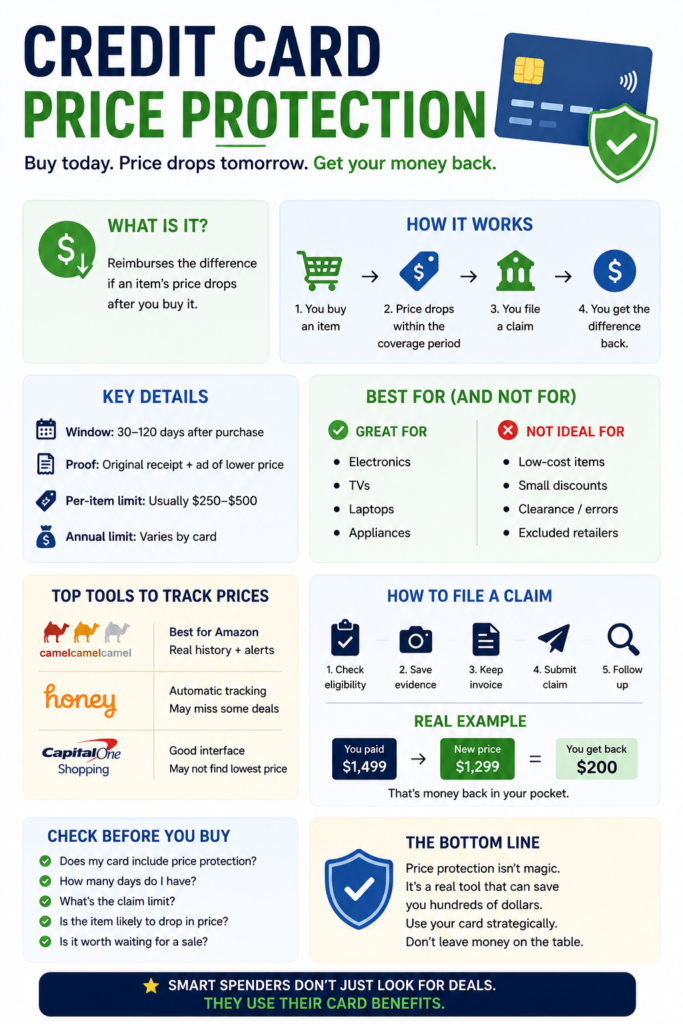
Take it with you
Download this image and review it carefully to better understand this benefit!
FAQ
Conclusion
Price protection is not magic. It is not marketing fluff either.
It is a real tool that can return money when used correctly.
That is the difference between buying and buying well.
If you want to improve your financial life in the U.S., stop treating your credit card like plastic.
Treat it like a strategic contract.
Because money is rarely lost through dramatic mistakes. Most of the time, it quietly disappears through small advantages you never used.

Related content
Smarter Options Before Fast Cash
Explore smarter emergency loan alternatives in the U.S. Avoid high-interest debt with faster, safer options before borrowing fast cash.
Keep reading * You will remain on the current website
I have been a content producer for over 10 years, specializing in online writing across a wide range of topics—particularly finance, health, and human behavior. I’m an expert in SEO-driven writing and cultural research.