Expense Ratios Explained: What They Really Cost Investors
Learn what expense ratios really cost investors and how hidden fund fees can quietly reduce returns over time.
How Expense Ratios Work Inside Investment Funds
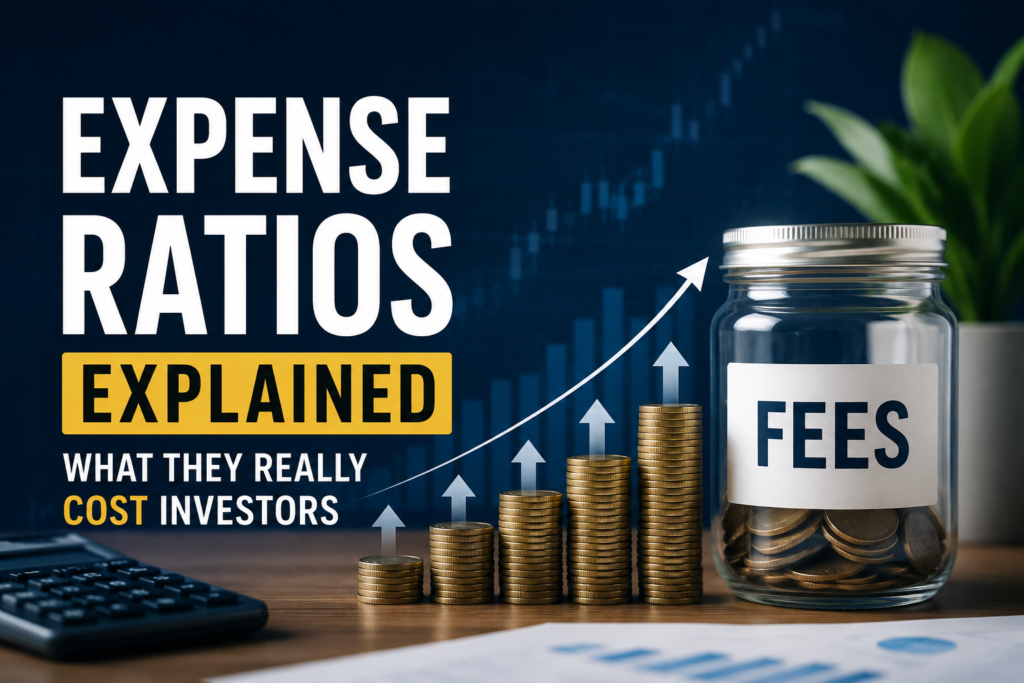
Most investors spend years chasing higher returns without ever stopping to ask a much more important question: what expense ratios really cost.
That is exactly why so many Americans quietly lose money inside perfectly “good” investments.
“You can survive average returns. You cannot easily recover from decades of unnecessary fees draining your portfolio.”
The hidden truth of long-term investing.
Most people never notice it until retirement projections start looking smaller than expected.
By then, the damage is already done.
The good news is that once you understand how these fees work, you can avoid one of the biggest long-term investing mistakes in America.
The Silent Fee Most Investors Never Notice
An expense ratio is the annual percentage a fund company charges to manage and operate an investment fund.
This fee covers things like:
- portfolio administration
- management staff
- compliance oversight
- recordkeeping systems
- internal operations
- marketing expenses
Unlike a monthly subscription, you never manually pay this bill.
It is quietly deducted from the assets inside the fund itself.
That means your money is shrinking in the background before returns ever reach your account.
This matters because invisibility creates complacency.
If investors had to manually approve every annual fund fee, many would immediately reject expensive products.
But because these costs stay hidden, millions accept them without resistance.
That is exactly how large financial institutions keep collecting billions every year.
📉 The Silent Fee Calculator
Assume an 8% annual market return. See exactly how much wealth an active fund (1.00%) destroys compared to a low-cost ETF (0.03%).
Why Tiny Percentages Become Massive Losses
Percentages look harmless. That is the psychological trap. A fee of 1% sounds trivial. After all, it is “only one percent.”
But investing compounds. And compounding works both ways.
It builds wealth when returns stay invested.
It destroys wealth when fees interrupt growth year after year.
Consider two investors.
Each starts with $100,000 and earns average market returns over three decades.
The only difference is cost structure.
| Investment Option | Annual Fee | Approximate Ending Value |
|---|---|---|
| Low-cost index ETF | 0.03% | $995,000 |
| Higher-cost active fund | 1.00% | $760,000 |
That difference exceeds $230,000.
Just a steady fee reducing compounding power every year.
This is what what expense ratios really cost looks like in practice.
And most investors underestimate it badly.
Why Low-Cost Leaders Changed the Industry
Few firms reshaped American investing more than Vanguard.
Its founder challenged the idea that investors needed expensive managers constantly making active decisions.
Instead, the company popularized broad-market indexing at ultra-low cost.
Its flagship products remain some of the cheapest available.
Where Investors Commonly Overpay
The biggest fee traps usually appear inside actively managed mutual funds.
These products often promise:
- expert market timing
- downside protection
- better stock selection
- smarter tactical allocation
Sometimes they deliver. Usually they do not.
Repeated long-term scorecards from major market analysts show most active managers fail to consistently outperform benchmark indexes after fees.
That creates a difficult question:
Why pay premium prices for statistically ordinary results?
Here is a broad comparison:
/htm
| Fund Style | Typical Fee Range | Long-Term Reliability |
|---|---|---|
| Passive ETFs | Very low | High consistency |
| Active mutual funds | Moderate to high | Highly variable |
The uncomfortable truth behind what expense ratios really cost is that many investors pay extra for complexity rather than actual performance.
Complexity sounds sophisticated.
But sophistication without results is just expensive decoration.
The Fee Illusion That Tricks Smart People
Everyday Life
A premium hotel or luxury car usually guarantees better engineering and quality.
“Higher prices equal higher quality.”
Wall Street
Expensive funds frequently reflect sales infrastructure, distribution costs, and branding.
“Expensive means more profitable for the firm selling it.”
How to Judge Whether a Fee Is Worth Paying
A useful framework looks like this:
The Expense Ratio Benchmark
Fees above one percent are not automatically bad.
But they demand extraordinary evidence.
And most funds fail that test.
Our opinion is blunt:
If a fund charges premium fees while delivering average results, investors are paying for storytelling—not value.
That happens more often than most people realize.
What Smart Investors Actually Look For
Before buying any fund, ask four questions.
Does a cheaper version exist?
Many funds track nearly identical indexes.
If one costs more, there should be a compelling reason.
Are returns measured after fees?
Gross performance means nothing.
Only net returns matter.
Is the strategy understandable?
If the explanation feels intentionally confusing, be cautious.
Good investing rarely requires mystery.
Has performance stayed consistent?
One lucky year proves very little.
Long-term reliability matters far more.
Frequently Asked Question

Related content
How to Avoid Credit Card Interest
Learn how to avoid credit card interest during back-to-school and holiday shopping with practical budgeting tips.
Keep reading * You will remain on the current website
I have been a content producer for over 10 years, specializing in online writing across a wide range of topics—particularly finance, health, and human behavior. I’m an expert in SEO-driven writing and cultural research.