How to Avoid Credit Card Interest During Back-to-School and Holiday Spending
Learn how to avoid credit card interest during back-to-school and holiday shopping with practical budgeting tips.
The Hidden Cost of Back-to-School and Holiday Purchases
Have you prepared to avoid credit card interest during back-to-school and holiday spending seasons?

In America, there are two times of the year that tend to wreck household budgets:
- Back-to-school season (July through September)
- Holiday shopping season (November and December)
The National Retail Federation estimates that American families spend hundreds of dollars per child during back-to-school shopping.
Meanwhile, holiday spending often exceeds $900 per consumer when you factor in gifts, travel, decorations, and special meals.
The problem is not spending money.
The real problem is putting it all on a credit card and pretending your “future self” will deal with it later.
Here is the blunt truth:
Credit card interest is a voluntary tax paid by people who fail to plan.
That may sound harsh, but it is true.
If you want to use credit without becoming trapped by it, you need strategy — not impulse.
What Does Credit Card Interest Really Cost?
A lot of people tell themselves “I’ll just carry a little balance into next month.”
That is exactly how the problem starts.
Here is a realistic example:
📉 The Minimum Payment Reality Check
Enter your planned holiday or back-to-school spending to see the true cost.
Most Americans do not realize that banks make their biggest profits the moment you think:
“I’ll just skip paying in full this month.”
Credit card rewards like cashback, airline miles, and points sound generous, but let’s be honest:
1% cashback will never offset 24% interest.
Rule #1: Pay the Statement Balance, Not the Current Balance
This mistake is incredibly common.
Your credit card app usually shows:
- Current balance
- Statement balance
- Minimum payment
The number you should focus on is the statement balance.
That is the full amount you must pay by the due date to avoid interest charges.
If you only pay the minimum, your bank loves you.
📱 Your Banking App
Which number do you pay?
If you pay the full statement balance, the bank is essentially giving you free short-term financing.
That is how financially smart people use credit cards.
The Best Credit Cards for This Season (And Where They Fall Short)
Chase Freedom Unlimited
Pros
- Reliable cashback rewards
- Excellent mobile app
- Strong fraud protection
- Above-average customer service
Cons
- High APR if you carry a balance
- Approval usually requires strong credit
My honest take:
Excellent if you always pay in full. Terrible if you tend to carry balances.
Discover it Cash Back
Pros
- Great for beginners
- Strong rotating cashback categories
- Highly rated customer support
Cons
- Lower international acceptance
- Initial credit limits can be modest
My view:
One of the best cards for learning financial discipline.
We have a dedicated article about this card — check it out here.
Capital One Quicksilver
Pros
- Simple structure
- Flat-rate cashback
- Easy-to-use app
Cons
- Fewer premium perks
- Best APR offers usually require excellent credit
My opinion:
It is the Toyota Corolla of credit cards.
Not flashy, but dependable.
See the best credit cards up to $1,000.
Store Credit Cards (Target, Macy’s, Kohl’s, Best Buy)
Let’s be direct:
In most cases, avoid them.
The opening discount sounds tempting:
“Save 20% today.”
But many store cards carry APRs close to 30%.
If you do not pay in full, that discount disappears fast.
This is emotional marketing disguised as financial value.
🏷️ The 20% Discount Illusion
Buy $500 in gifts.
“Save 20% today!” (-$100)
Your brain feels like a genius.
You carry the $400 balance.
Hit by 29.99% Store APR.
The discount disappears. You are now paying extra for those same gifts.
The Right Strategy for Back-to-School and Holiday Spending
Follow this plan:
1. Set a Spending Limit Before Shopping
Example:
- School supplies: $600
- Clothes: $300
- Gifts: $500
- Decorations: $150
Total: $1,550
Without limits, you improvise.
Improvisation creates debt.
2. Divide Spending Across Paychecks
If you are paid biweekly:
$1,550 ÷ 4 paychecks = $387.50
Now you know exactly how much to reserve from each paycheck.
That turns chaos into math.
3. Turn On Autopay for the Full Statement Balance
This is probably the most powerful financial hack in America.
Set automatic payment for the full statement amount.
This eliminates:
- Forgetfulness
- Late payments
- Fees
- Unnecessary interest
Late fees can exceed $30 per missed payment.
That is money thrown away.
4. Use 0% APR Promotions Carefully
Some cards offer:
- 12 months
- 15 months
- Up to 21 months interest-free
This can be useful only if you have a real payoff plan.
If you are just delaying the problem, it becomes a financial time bomb.
Promotional APR does not solve poor organization.
It only buys time.
The Emotional Mistake That Hurts American Families
American culture constantly pushes this message: “Your family deserves a big holiday season.”
That is true.
But that does not mean financing a Christmas you will still be paying off by next summer.
Expensive gifts do not create better memories.
Financial stress ruins more celebrations than modest gifts ever could.
If you have to choose between:
- Impressing people today
- Breathing financially tomorrow
Choose tomorrow.
Every time.
🚩 Warning Signs You Are Using Credit Wrong
Be honest. Check the boxes that apply to your habits:
If this sounds familiar, the problem is not your credit card.
It is automated financial behavior.
And automated financial behavior gets expensive fast.
The Method That Actually Works
People think financial control is about willpower. It is not.
It is about systems. The ideal system:
Every Friday (10 minutes), review:
- Your card balance
- Your statement closing date
- Your payment due date
- Weekly spending
- How much money is already reserved for payment
This tiny habit prevents most common financial mistakes.
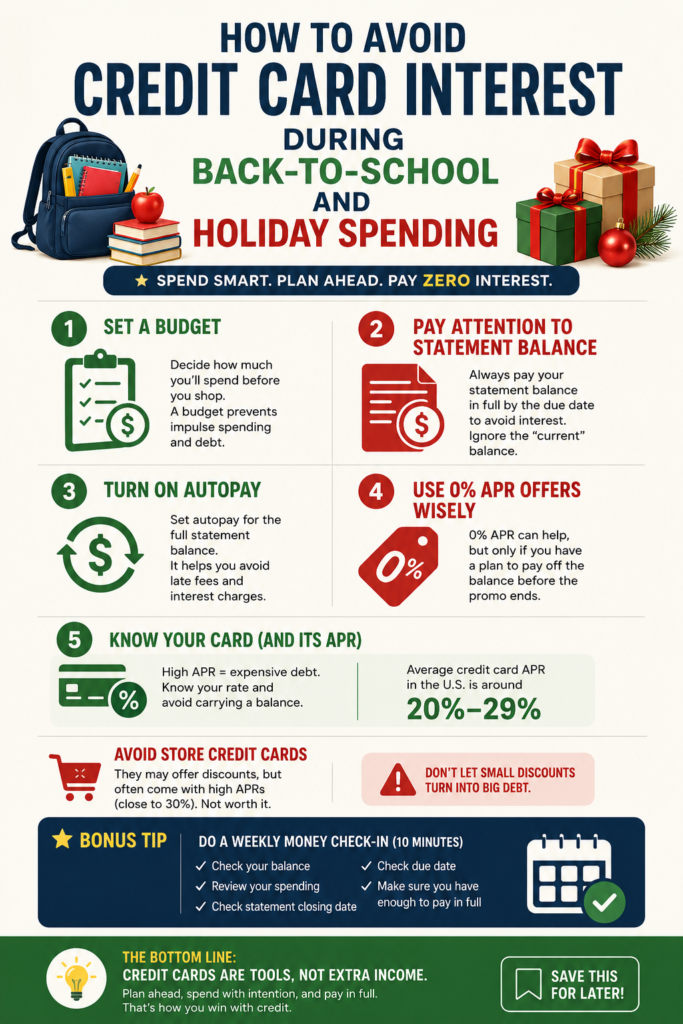
Take this with you
Save this image to your phone and get prepared.
Final Thought
If you remember only one thing from this article, remember this:
A credit card is not extra income.
It is a tool.
In the right hands, it builds cashback, convenience, and strong credit.
In the wrong hands, it creates years of silent interest charges.
During back-to-school and holiday spending seasons, the entire market is designed to make you spend emotionally.
Your job is to do the opposite: Plan.
Because avoiding credit card interest does not require financial genius.
It only requires one adult decision:
Never spend today what your 60-days-from-now self cannot afford to pay off.
That is the real secret to using credit wisely in the United States.
Frequently Asked Questions
Related content
APR vs. Origination Fee Explained Simply
Understand APR and origination fees to compare personal loan offers clearly and avoid hidden borrowing costs.
Keep reading * You will remain on the current website
I have been a content producer for over 10 years, specializing in online writing across a wide range of topics—particularly finance, health, and human behavior. I’m an expert in SEO-driven writing and cultural research.