APR vs. Origination Fee Explained Simply
Understand APR and origination fees to compare personal loan offers clearly and avoid hidden borrowing costs.
Learn the difference between APR and origination fees now
When researching personal loans in the United States, two numbers usually appear right away: APR and the origination fee.
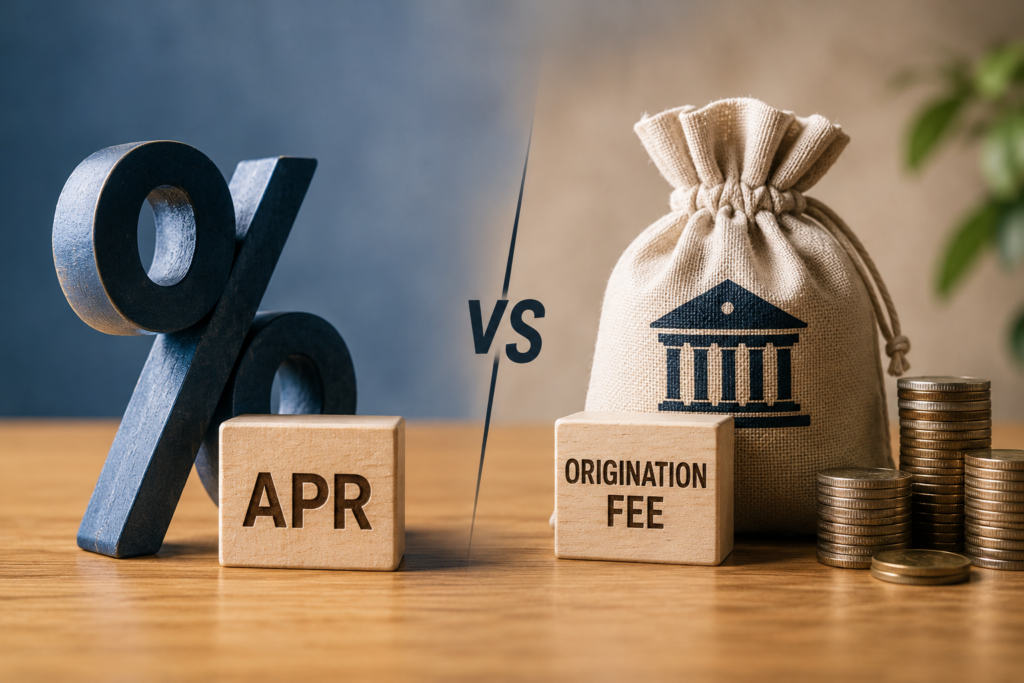
A large number of consumers choose loans based only on the monthly payment or the APR highlighted on the first screen.
The market knows this. In many cases, lenders structure their offers to look more attractive than they really are.
That’s where the mistake happens.
If there is one strong opinion that needs to be stated clearly, it is this:
Comparing loans based only on APR is an incomplete analysis — and incomplete analysis usually becomes expensive.
According to the Truth in Lending Act, overseen by the Consumer Financial Protection Bureau, APR exists specifically to standardize comparisons between loan offers and help consumers better understand the real cost of credit in the United States.
The problem is that many people still interpret this number incorrectly.
What is APR?
APR stands for Annual Percentage Rate.
It represents the annualized cost of the loan and usually includes interest plus certain mandatory finance charges.
In practice, it was created to make comparisons easier.
The logic seems simple: The lower the APR, the better the loan.
But that is not always true.
The second offer has a lower nominal interest rate.
Even so, the real cost may be much higher.
That is exactly why APR exists.
According to CFPB guidance, consumers often confuse nominal interest rates with effective total borrowing cost.
That confusion leads to poor decisions every day.
What is an origination fee?
An origination fee is the charge a lender applies to process the loan.
In the United States, it typically ranges from 1% to 8%, although some borrowers may face higher fees depending on credit profile.
Most lenders deduct this fee upfront.
Here’s how it works:
You request: $10,000. Origination fee: 5%. Actual cash received: $9,500.
But you continue making payments based on the full $10,000.
The Origination Fee Reality Check
See how much usable cash you actually get.
The Trap: You only got $9,500, but you will pay interest on the full $10,000.
The Consumer Financial Protection Bureau warns that upfront fees can significantly reduce usable loan proceeds, especially when borrowers focus only on monthly payments.
And this happens constantly.
The classic comparison mistake
Many borrowers compare two offers like this:
Loan A
APR
- ✅ $0 Origination Fee
- ✅ You get exactly $10,000
Loan B
APR
- ❌ 6% Origination Fee
- ❌ You only get $9,400
And automatically choose Loan B.
It looks better.
But depending on the repayment term, total cost may actually be higher.
This is where lenders win.
The Federal Trade Commission frequently warns consumers about financial offers that emphasize attractive rates while minimizing visibility of important fees.
If an offer looks too simple, it probably deserves a closer read.
How to compare correctly
Always answer these three questions:
The Transparency Framework
1. How much cash will I actually receive?
If you need $15,000 to consolidate debt, but the loan has a 5% fee, you will only receive $14,250. You will still be short $750 to pay off your old debts.
2. How much will I repay in total?
This is the principal + the origination fee + all the interest generated over the years. This number destroys the illusion of the low monthly payment.
3. What will this cost month to month?
Does this fit your current budget without relying on future raises or bonuses? If the lender hides this number behind a long application, walk away.
Use this framework: If a lender does not show these clearly, that is a warning sign.
Real transparency does not hide.
SoFi: excellent for strong borrowers
SoFi often offers clear structures and frequently no origination fee.
Strengths
- high transparency
- competitive rates
- strong platform
Weaknesses
- selective approvals
- less friendly for average credit profiles
Our view:
Excellent for financially established borrowers.
Difficult for those rebuilding credit.
Upstart: accessible, but requires attention
Upstart expanded approvals using alternative underwriting.
Strengths
- accessibility
- fast approvals
Weaknesses
- higher fees for some borrowers
- total cost can rise quickly
Good option.
But disclosure review is essential.
Discover Personal Loans: rare honesty
Discover Financial Services usually keeps things simple.
Strengths
- zero origination fee
- clear disclosures
- predictability
Weakness
- stricter approval standards
Our take: One of the most straightforward offers in the market.
And financial honesty has real value.
The American market is full of companies offering personal loans.
You can also explore other alternatives for getting emergency cash.
Why this matters so much today
According to the Federal Reserve Bank of New York Household Debt Report, American household debt remains elevated.
That means small contractual differences matter more than ever.
When borrowers accept credit without understanding total cost, the consequences can last for years.
And the entire market knows it.
The biggest myth in lending
Many people believe lower APR always wins.
That is false.
The Biggest Lending Myth:
“A lower APR always means a better loan.”
This is math. Not marketing.
Our honest view: most Americans compare loans the wrong way
Here is the uncomfortable truth:
The personal loan market in the United States often depends on borrower distraction.
That sounds harsh, but it is accurate.
Many lenders know that most consumers focus on three things:
- the monthly payment
- the advertised APR
- whether approval is instant
That’s exactly why deeper costs are often buried in disclosure documents that few borrowers actually read.
The system is technically transparent.
But practical clarity is a different story.
That distinction matters.
At our site, we believe consumers should evaluate personal loans the same way investors evaluate assets: by looking at total cost, structural risk, and long-term financial impact.
That means ignoring flashy marketing language and focusing on numbers that actually affect your financial life.
Here is the framework we recommend every borrower use before accepting any offer:
Calculate actual cash received
Project total repayment cost
Compare at least 3 lenders
Reject anything unclear
Final checklist before accepting
Loan comparison checklist
- Actual APR
- Origination fee
- Cash received
- Total repayment
- Late fees
- Prepayment penalties
- Autopay discounts
If any of these are unclear:
Pause. Ask questions. Confirm. Then sign.

Related content
Your Home Insurance Deductible Guide
Learn how to choose the right home insurance deductible and balance monthly savings with real financial protection.
Keep reading * You will remain on the current website
I have been a content producer for over 10 years, specializing in online writing across a wide range of topics—particularly finance, health, and human behavior. I’m an expert in SEO-driven writing and cultural research.