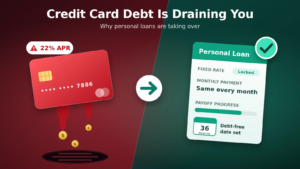
Plan Summer Without Credit Dependence
Plan a smarter summer budget and enjoy more freedom without relying on debt, credit card stress, or costly impulse spending.
Spend Smart This Summer

America has an interesting pattern: summer usually comes with extra spending.
Last-minute trips, barbecues, road trips, festivals, more expensive airfare, kids out of school, higher energy bills, and that classic feeling:
“I deserve to enjoy this now, and I’ll deal with it later.”
That “later” usually shows up in September as high credit card balances, revolving interest, a messy budget, and financial guilt.
And here is this site’s clear position:
If your summer depends on credit to exist, it is already too expensive.
That may sound harsh, but it is practical.
According to the Federal Reserve Consumer Credit Report, revolving credit in the U.S. remains elevated, while credit cards often carry APRs above 20%.
It means a $2,500 trip charged on impulse can easily cost far more once interest enters the picture.
The problem is not enjoying summer.
The problem is financing memories with expensive debt.
☀️ Summer should create memories.
Not financial regret in September.
Why does summer destroy so many budgets?
Summer in the U.S. is emotionally expensive.
It triggers things like:
- social urgency (“everyone is traveling”)
- digital comparison (Instagram packed with vacation photos)
- financial FOMO
- impulse spending for convenience
According to research from the American Psychological Association, impulsive financial decisions increase in emotional and social environments.
In other words: Your brain spends worse when it wants to experience something right now.
This is not a discipline failure. It is predictable behavior.
And predictable behavior can be planned for.
The real cost of an “installment summer”
Take a look:
| Typical Expense | Average Cost |
|---|---|
| Domestic travel | $1,200–$2,500 |
| Road trip gas | $250–$700 |
| Hotels | $800–$2,000 |
| Extra dining | $300–$900 |
| Events | $150–$600 |
Now imagine putting $4,000 on a card with 24% APR while making minimum payments.
The result? You could still be paying for part of that summer by the following winter.
That is not freedom.
That is emotional rent with compound interest.
Rule #1: Budget before the season starts
Most people plan summer like this: “We’ll figure it out.”
Financially, that is the equivalent of driving without GPS.
Real planning means defining:
How much you can spend
Without revolving credit.
What you will spend it on
Real priorities.
When you will spend it
Smart distribution.
Example:
A family in Austin with $6,500 monthly net income
| Category | Summer Budget |
|---|---|
| Travel | $1,800 |
| Local entertainment | $500 |
| Kids | $300 |
| Extras | $400 |
| Surprise reserve | $300 |
Total: $3,300
Planned, controlled, and debt-free.
Tools that actually help
YNAB
Pros
- excellent active planning
- builds intentional spending habits
Cons
- learning curve
- paid subscription
Ideal for people serious about discipline.
Rocket Money
Pros
- simple
- user-friendly interface
Cons
- less detailed control
Great for beginners.
Monarch Money
Pros
- strong design
- family-friendly visibility
Cons
- premium pricing
Excellent balance.
Our honest opinion:
If you have never budgeted for an entire summer, start simple.
Do not turn planning into a hobby.
Turn it into a system.
💡 Smart move:
Summer spending works best when decided in spring.
The classic mistake: confusing credit limit with budget
This destroys young adults in the U.S.
You see available credit and think: “I can spend this.”
Reality: You can borrow this.
Those are not the same thing.
According to the Consumer Financial Protection Bureau, high credit utilization is one of the biggest drivers of financial deterioration.
Available credit is not available money.
Repeat that until it becomes instinct.
The practical method: the summer 60/20/20 rule
Split your money like this:
| Purpose | Percentage |
|---|---|
| Planned experiences | 60% |
| Small spontaneous fun | 20% |
| Emergency reserve | 20% |
Example:
Summer budget: $2,000
- $1,200 main travel/fun
- $400 casual spending
- $400 financial protection
This prevents the classic:
“We spent everything in the first month.”
Should you use credit cards?
Yes. But with purpose.
Credit cards should be tools for:
- cashback
- points
- purchase protection
- organization
Not survival. Useful examples:
American Express
Pros
- outstanding benefits
Cons
- lower acceptance
Chase
Pros
- strong rewards
Cons
- easy to overspend
Capital One
Pros
- excellent UX
Cons
- inconsistent rewards structure
Our point: Use a card if the money already exists.
Never use it to invent a budget.
📅 Plan ahead
Define limits early
💳 Spend consciously
Track every category
🛟 Keep backup cash
Protect flexibility
How to fund summer without relying on credit
Simple strategy:
If summer is 4 months away:
Goal: $2,400
Divide by 4: $600 per month
Automate it. Separate account. Done.
That changes everything.
According to the FINRA Foundation National Financial Capability Study, automation significantly improves financial consistency because it reduces psychological friction.
The biggest summer money myth
“I’ll make up for it later.”
That almost never happens.
September arrives with:
- back-to-school costs
- unexpected expenses
- normal life restarting
- stacked bills
And the “future adjustment” disappears.
Good planning protects you from your overly optimistic future self.
🔥 Smart rule:
If summer needs debt to happen, scale it down.
Final checklist
Before any major expense, ask:
✓ Is this in the budget?
✓ Do I have cash reserved?
✓ Am I using credit strategically or out of necessity?
✓ Will this hurt August or September?
✓ Would I make this purchase in cash?
If the answer is “no” to several:
Stop.
Reassess.
💭 The right question is not:
“Can I put this on my card?”
👉 It is:
“Can I afford this without future stress?”
Summer Is Not About Spending More
One of the biggest financial mistakes Americans make is assuming a better summer requires more money.
It does not.
The smartest way to enjoy summer is to shift focus from buying experiences to creating experiences.
Here are practical ways to do that:
- Explore free local events like concerts, outdoor movie nights, and city festivals
- Plan day trips instead of expensive overnight travel
- Host potluck barbecues instead of dining out
- Visit state parks instead of premium attractions
- Create “no-spend weekends” with outdoor activities
- Use library passes for museums and attractions
- Rotate low-cost group activities with friends
The goal is simple:
Make summer memorable, not expensive.
☀️ Better summer rule
Focus on moments, not purchases.
The best summers are rarely the most expensive.
They are usually the most intentional.
Conclusion
The American financial system loves consumers who enjoy an amazing summer and spend the rest of the year paying for it.
Because emotional debt is profitable.
Our view is simple:
Real financial freedom means enjoying the present without hijacking your future.
Plan. Prepare. Automate. Adjust expectations.
And build a summer that ends with great memories — not interest charges.
Frequently Asked Questions

Related content
Credit Card Price Protection Explained
Learn how credit card price protection works and recover money when eligible purchases drop in price.
Keep reading * You will remain on the current website
I have been a content producer for over 10 years, specializing in online writing across a wide range of topics—particularly finance, health, and human behavior. I’m an expert in SEO-driven writing and cultural research.