
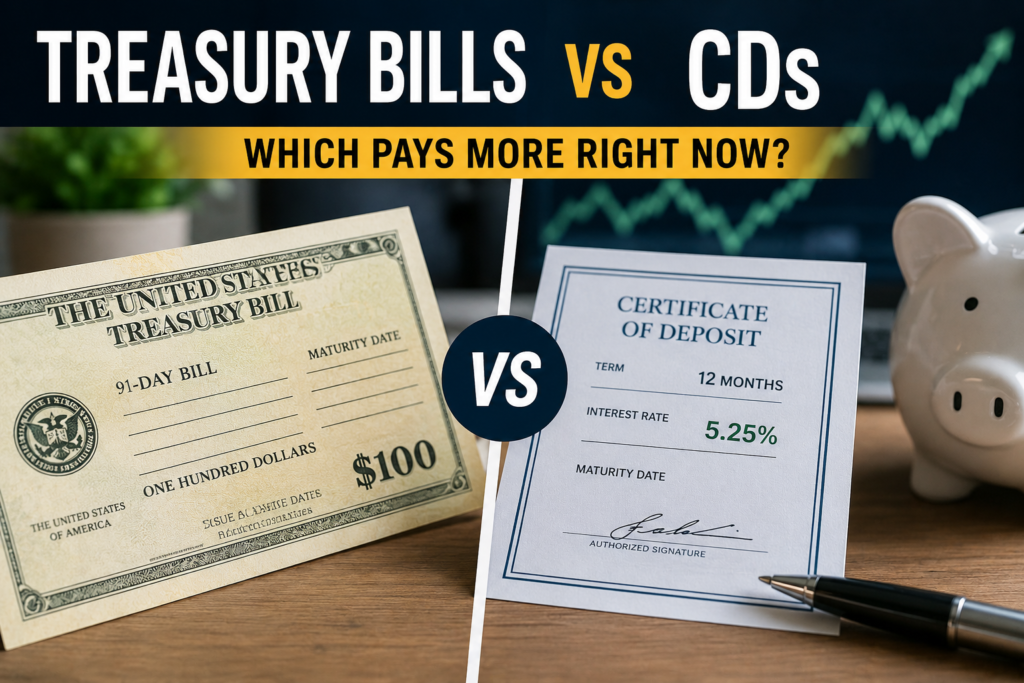
Treasury Bills vs CDs: Which Pays More Right Now?
Compare Treasury Bills and CDs to understand which option pays more and fits short-term savings goals today.
Understanding Treasury Bill and CD Rates
For years, Americans treated savings accounts like financial furniture.
Money sat there quietly. Nobody expected much from it. And honestly, interest rates were so low that many people stopped caring entirely.
Now millions of Americans are asking the same question:
And more importantly: Which one actually pays more right now?
The answer is not as simple as financial influencers make it sound. Because while Treasury Bills (T-Bills) and Certificates of Deposit (CDs) are both considered low-risk savings tools, they behave very differently depending on: interest rates, liquidity needs, taxes, bank competition, and economic conditions. And for everyday Americans trying to protect cash without becoming financial experts overnight, understanding those differences matters a lot.
🏛️ Understanding Treasury Bill and CD Rates
Before comparing returns, it helps to understand what these products actually are. Because many people invest in them without fully understanding how they work. That usually leads to bad decisions.
🦅 What Are Treasury Bills?
Treasury Bills are short-term securities issued by the U.S. government. When you buy one, you are basically lending money to the federal government for a short period.
Common maturities:- 4 weeks, 8 weeks, 13 weeks, 26 weeks, 52 weeks
Instead of paying traditional interest, T-Bills are sold at a discount.
- Buy for: $980
- Receive at maturity: $1,000
- Your profit: $20
Because they are backed by the U.S. Treasury, T-Bills are considered among the safest investments in the world.
🏦 What Are CDs?
Certificates of Deposit are banking products. You deposit money into a bank for a fixed period, and the bank pays a guaranteed interest rate.
Common CD terms:- 3 months, 6 months, 1 year, 5 years
Your money is usually locked during the term. If you withdraw early, penalties often apply. That tradeoff is important.
📈 Which Pays More Right Now?
Here’s the honest answer: In many recent market conditions, Treasury Bills have often outperformed traditional CDs. But not always. And that distinction matters.
Why Treasury Bills Became So Popular
After Federal Reserve rate hikes, Treasury yields climbed rapidly. Meanwhile, many large traditional banks were surprisingly slow to raise savings and CD rates. That frustrated consumers.
Imagine this situation:
That gap pushed many Americans toward Treasury products. Especially younger savers who became more rate-conscious online.
Current Rate Environment Comparison
| Product | Typical Yield Range |
|---|---|
| 🦅 Treasury Bills | Often highly competitive |
| 💻 Online Bank CDs | Competitive |
| 🏛️ Traditional Bank CDs | Frequently lower |
| 🏦 Standard Savings Accounts | Usually weakest |
Important: rates constantly change based on Federal Reserve policy and market conditions. But historically, online banks tend to offer stronger CD yields than major legacy banks.
🏛️ The Big Banks: Pros and Cons
Many Americans still use large banks because of convenience, branch access, familiarity, and bundled services. But when it comes to savings yields? Large traditional banks often disappoint.
JPMorgan Chase
Positives- Massive branch network
- Strong customer support
- Reliable mobile banking
- Lower savings yields historically
- CDs often less competitive than online banks
Bank of America
Positives- Strong digital ecosystem
- Good integration with Merrill accounts
- Savings rates often extremely low
- CD yields frequently lag market leaders
Wells Fargo
Positives- Broad accessibility
- Easy in-person banking
- Savings products usually not yield-focused
- Rates often weaker than online competitors
Why Online Banks Changed the CD Market
Online banks became aggressive during high-rate environments. Institutions like Ally Bank, Marcus by Goldman Sachs, Discover Bank, and Capital One 360 started offering much stronger CD yields.
Why? Because online banks compete aggressively for deposits. Without expensive branch networks, they often pass more yield to customers.
🛡️ Treasury Bills Have a Huge Tax Advantage
This is one of the biggest points many beginners miss.
That difference matters significantly in high-tax states like California, New York, and New Jersey.
A Treasury yield and CD yield may look identical initially. But after taxes? The Treasury Bill may produce a better effective return. For many investors, that changes the entire comparison.
💧 Liquidity: The Hidden Factor Everyone Ignores
People obsess over rates. But liquidity matters just as much.
🦅 Treasury Bills
Advantages:- Short maturities
- Easy reinvestment
- Strong flexibility
- Can be sold before maturity
- Slightly more complex for beginners
- TreasuryDirect interface feels outdated
🏦 CDs
Advantages:- Fixed predictable returns
- Simple structure
- Easy for beginners
- Early withdrawal penalties
- Less flexibility
- Money feels “trapped”
This matters more than most people realize. Especially for younger Americans with unpredictable finances.
💻 Platforms and Psychology
TreasuryDirect: Powerful but Frustrating
If you buy T-Bills directly from the government, you usually use TreasuryDirect. And honestly? The platform feels ancient.
The website experience is widely criticized for outdated design, clunky navigation, and confusing account recovery. Financially, the product is excellent. Technologically, it feels like a museum exhibit. That frustrates many younger investors used to modern fintech apps.
Brokerages Make T-Bills Easier
Many Americans now buy Treasury Bills through brokerages instead (like Fidelity, Charles Schwab, Vanguard).
- Advantages: easier interfaces, better portfolio tracking, integrated investing tools.
- Disadvantages: slightly more learning required, reinvestment setup varies.
For beginners, brokerages often provide a smoother experience than TreasuryDirect itself.
CDs Are Easier Emotionally
This matters more than finance experts admit. CDs simplify decision-making. You deposit money. You wait. You receive interest. That structure creates psychological comfort. For some savers, especially people nervous about investing, simplicity reduces financial stress. And reducing stress is valuable.
🛑 Common Mistakes & Strategies
Common Mistakes Americans Make
- Chasing Tiny Rate Differences Constantly: Switching accounts every two weeks rarely changes your financial life dramatically.
- Ignoring Taxes: After-tax yield matters more than headline yield.
- Forgetting Liquidity: Higher returns are meaningless if access to money becomes a problem.
- Staying Loyal to Weak Banks: Banks are businesses. They are not emotionally attached to you. Consumers should compare rates rationally.
But Simplicity Can Become Expensive
Many Americans stay loyal to low-yield banks because of habit, convenience, and fear of change. Meanwhile, inflation quietly reduces purchasing power. This is where our opinion becomes very direct:
Americans dramatically underestimate the cost of leaving cash in weak savings products. Loyalty to a bank should never cost you meaningful yield. Yet millions of consumers accept terrible rates simply because moving money feels inconvenient. That mindset quietly destroys long-term financial efficiency.
Which Option Is Better for Emergency Funds?
This depends on flexibility needs.
- Treasury Bills work well when: you want short maturities, competitive yields, and value flexibility.
- CDs work better when: you know you won’t touch the money, want fixed predictable returns, and prefer simplicity.
For younger adults? T-Bills often make more sense. Life changes fast in your 20s and 30s. Liquidity matters.
(Remember: Inflation changes everything. A lot of people celebrate earning 4%, 5%, or 5.5%. But if inflation remains elevated, real purchasing power growth shrinks. That’s why choosing stronger cash-management products matters.)
⚖️ Which One Should Most Americans Choose Right Now?
Here’s the honest answer:
Treasury Bills are currently one of the strongest short-term cash options available for many Americans. Especially when rates are elevated, flexibility matters, taxes matter, and safety matters.
But CDs still have value. Particularly for conservative savers, fixed timelines, and people wanting guaranteed rates during uncertain markets.
⚡ Our Strong Opinion
Most Americans should pay far more attention to how their cash is managed. People spend endless hours debating stocks, crypto, and market predictions… while leaving large amounts of money sitting in weak savings products earning almost nothing. That is financially inefficient.
Treasury Bills have exposed how poorly many traditional banks reward loyal depositors. And honestly? That is a healthy wake-up call for consumers. Because modern cash management matters. A lot.
🏁 Final Thoughts
The Treasury Bills vs CDs debate is not really about finding a universal winner. It is about understanding your flexibility needs, your tax situation, your comfort level, and your financial goals.
- Right now, Treasury Bills often provide stronger overall value for many Americans because they combine competitive yields, government backing, tax advantages, and liquidity.
- Meanwhile, CDs remain useful for people prioritizing simplicity, predictability, and fixed returns.
The important thing is this: Cash should still work for you. And in today’s economy, leaving money parked in low-paying accounts simply because it feels familiar is no longer a smart financial strategy.
❓ FAQ: Treasury Bills vs CDs
Quick answers to help you navigate your cash management options.

Related content
Open Enrollment Insurance Checklist
Use this Open Enrollment Insurance Checklist to compare plans, lower risks, and avoid costly coverage mistakes.
Keep reading * You will remain on the current website
I have been a content producer for over 10 years, specializing in online writing across a wide range of topics—particularly finance, health, and human behavior. I’m an expert in SEO-driven writing and cultural research.