
Your Home Insurance Deductible Guide
Learn how to choose the right home insurance deductible and balance monthly savings with real financial protection.
How Much Risk Should You Keep?

If there is one quiet financial decision that can cost American families thousands of dollars, it goes by a surprisingly unexciting name: deductible.
Most people choose their home insurance deductible the same way they accept terms of service:
without really reading it and hoping they never need to use it.
That works… Until it does not. Here is this site’s clear position:
Choosing a deductible without strategy is basically gambling with your house.
According to the Insurance Information Institute, the average annual cost of homeowners insurance in the U.S. now exceeds $1,700, varying widely depending on state, climate risk, and property profile.
The difference between a smart deductible and a careless one can mean saving hundreds each year — or facing financial disaster at exactly the wrong moment.
And yes: that deserves your attention.
🏠 Insurance should reduce stress.
Not surprise you when your ceiling starts leaking.
What is a deductible?
Let’s simplify it. A deductible is the amount you pay out of pocket before your insurance company covers the rest.
Example:
- Total damage: $12,000
- Your deductible: $2,000
- Insurance covers: $10,000
- You pay: $2,000
Simple. But here is the important catch:
The higher your deductible, the lower your monthly premium usually becomes.
That sounds great — until you actually need to file a claim.
The classic American mistake
A lot of people think:
“I’ll choose the highest deductible and save money every month.”
That can work. But only if you have cash available.
If not, you have created an invisible financial trap.
It is like buying a giant umbrella and discovering, during a storm, that it costs $5,000 to open it.
What does each choice cost?
Here is a typical example:
| Deductible | Estimated Annual Premium |
|---|---|
| $500 | $2,050 |
| $1,000 | $1,820 |
| $2,500 | $1,530 |
| $5,000 | $1,250 |
The savings look tempting.
But ask yourself:
If your home is damaged tomorrow, could you comfortably pay that amount?
That is the only question that matters.
The realistic rule
Your ideal deductible should meet at least one of these conditions:
✓ already saved in cash
✓ immediately accessible without debt
✓ does not destroy your emergency fund
If you would need to finance your deductible, it is too high. Period.
🔥 Smart deductible rule:
If paying it would create debt, it is not smart savings.
How Americans usually get this wrong
Choosing based only on monthly price
A lower premium feels like winning. Until the claim happens.
Price alone is an illusion.
Ignoring local climate risk
Live in Florida?Hurricanes matter.
Texas? Hail matters.
California? Wildfire risk matters.
Your deductible should match your climate reality.
Confusing monthly savings with financial strategy
Saving $40 per month while exposing yourself to a $5,000 risk may be terrible math.
Always run the numbers.
Simulated case: David in Houston
David wanted to “optimize expenses.” He chose a $5,000 deductible.
Annual savings: $420.
Looked smart. Seven months later:
Severe storm damage.
Repair cost: $11,000. He did not have the cash.
Result: He financed the deductible on a credit card charging 24% APR.
His “savings” became expensive debt.
That is not efficiency. That is badly calculated risk.
How much risk should you actually keep?
Here is our strong opinion: Most American households should stay between $1,000 and $2,500.
Why?
Because it balances:
- reasonable premiums
- meaningful protection
- manageable financial exposure
Deductibles above that only make sense if your cash reserves are genuinely strong. Not optimistic.
Actually strong.
Comparing popular insurers
State Farm
- Pros:
strong reputation
reliable local service
- Cons:
rates can climb quickly
Good for stability.
Allstate
- Pros:
strong digital tools
- Cons:
complaint patterns vary by region
Good for aggressive comparison shopping.
Progressive
- Pros:
competitive bundling
- Cons:
customer experience can depend on partners
Good for pricing.
USAA
- Pros:
excellent customer satisfaction
- Cons:
limited eligibility
If you qualify, it is usually worth serious consideration.
Our view: The brand matters less than reading the contract carefully.
Do not buy logos. Buy coverage.
💰 Lower premium
Feels cheaper today
⚠️ Higher deductible
Hurts more later
⚖️ Balance matters
Smart beats cheap
How to test your deductible choice
Try this exercise. Imagine your roof is damaged tomorrow.
Could you pay your deductible:
- without using a credit card?
- without taking a loan?
- without selling investments?
- without panicking?
If not: it is too high.
Insurance should lower anxiety, not postpone it.
Should you raise your deductible to save money?
Sometimes. If the savings justify it.
Example:
Raising your deductible from $1,000 to $2,500 saves $300 annually.
It would take five years to offset the extra $1,500 exposure.
Worth it? Maybe.
That depends on your actual cash position and real risk tolerance.
Not hope. Math.
💡 Financial move
Insurance decisions should be based on numbers, not hope.
Your emergency fund changes everything
If you have:
- 6–12 months saved
- high liquidity
- stable budgeting habits
You can reasonably take on a larger deductible.
If you live paycheck to paycheck?
Extra protection matters more than monthly savings.
A lot of people try to look financially sophisticated by taking excessive risk.
That is not sophistication. That is financial cosplay.
💭 The right question is not:
“How low can my premium go?”
👉 It is:
“How much risk can I truly afford tomorrow?”
The uncomfortable truth
The insurance market loves customers who only look at monthly price. Because that makes selling easier.
But your home is not a streaming subscription.
It is wealth.
Our opinion is direct: If you do not understand your deductible, you do not understand your protection.
And that is dangerous.
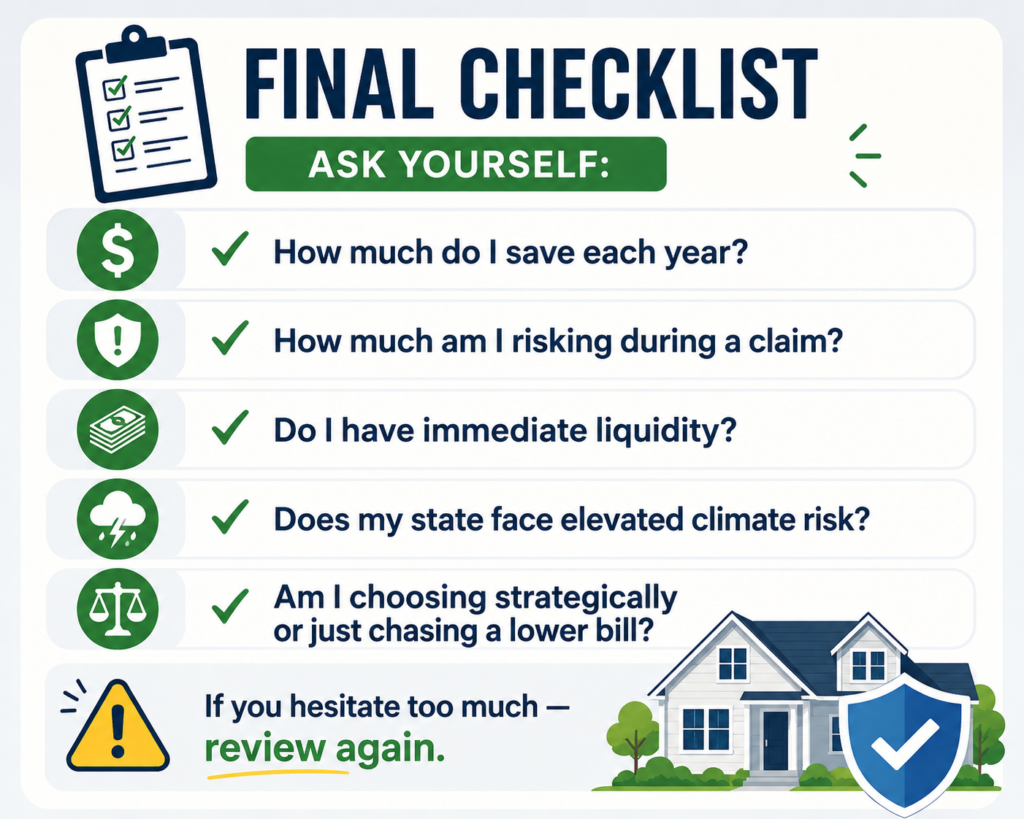
Conclusion
Financially smart Americans do not buy insurance to save a few dollars per month.
They buy predictability. They choose deductibles intentionally.
With math. With clarity.
Because when something goes wrong at home, the last thing you want is realizing you “saved money” in exactly the wrong way.
Your deductible should not be the lowest possible.
It should not be the highest possible. It should be the smartest choice for your real life.
Frequently Asked Questions

Related content
Plan Summer Without Credit Dependence
Plan a smarter summer budget and enjoy more freedom without relying on debt, credit card stress, or costly impulse spending.
Keep reading * You will remain on the current website
I have been a content producer for over 10 years, specializing in online writing across a wide range of topics—particularly finance, health, and human behavior. I’m an expert in SEO-driven writing and cultural research.